Material
Flow behavior, bulk density, moisture, grain structure and abrasiveness.
Move material from the feed point to your process through an enclosed conveying line designed for your plant layout.
From bag dumping to a mixer, from a big-bag station to a production machine: Infomak EHK moves bulk solids with a flexible spiral rotating inside a tube.
Few moving parts · Easy servicing · Accessible cleaning
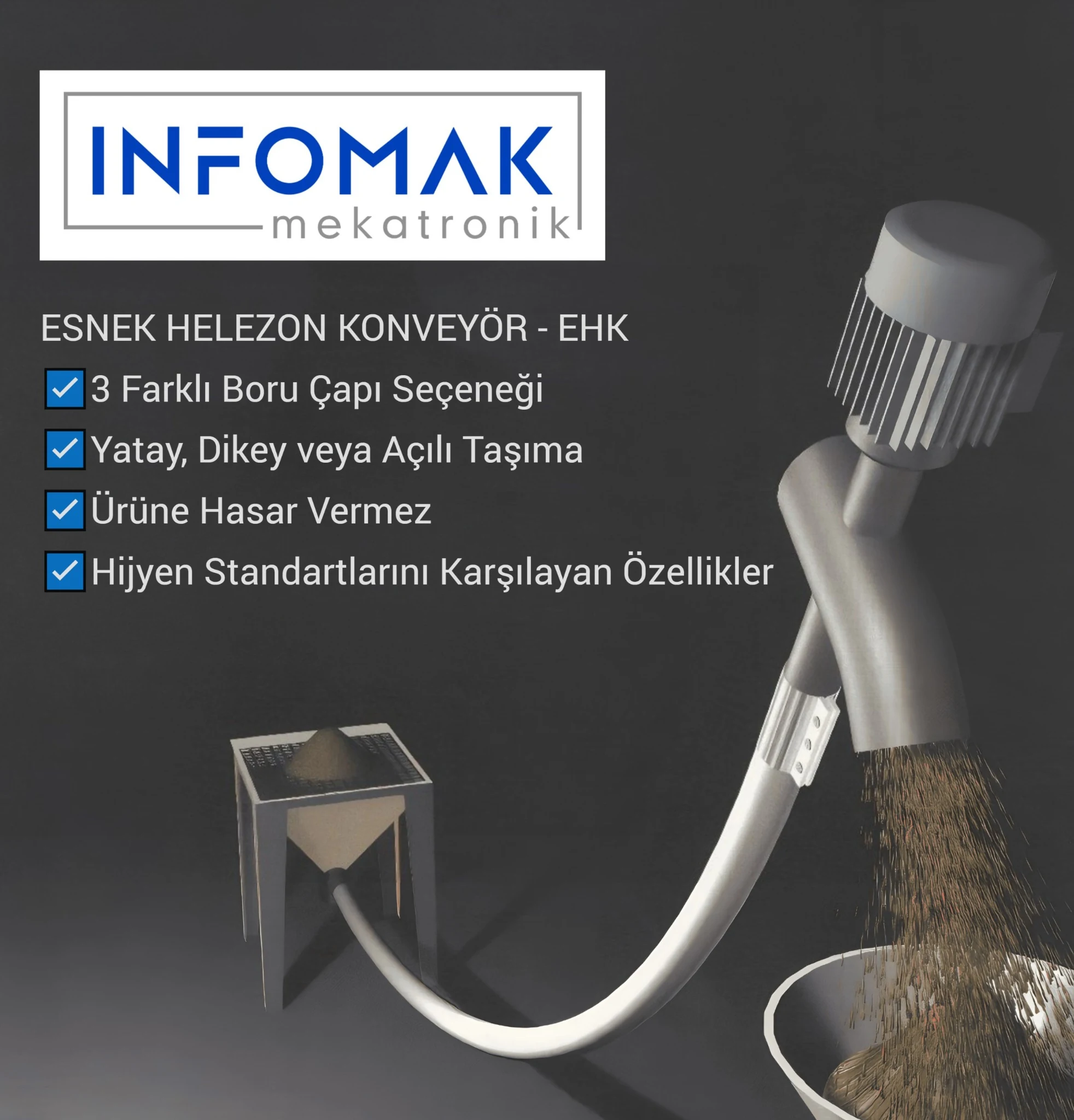
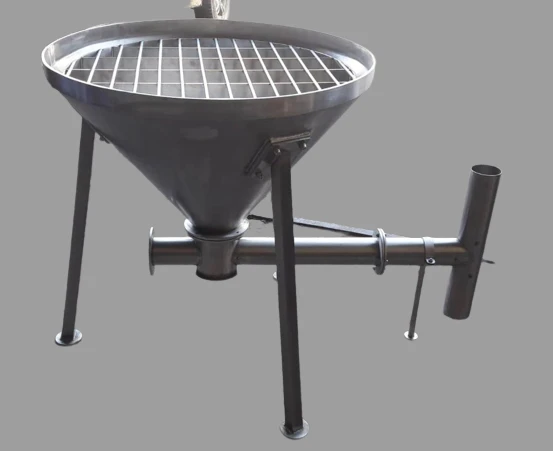
EHK is a bulk solids conveying system known internationally as a flexible screw conveyor. Material reaching the feed hopper or inlet connection travels along the tube to the outlet, driven by a motor-powered flexible spiral.
Under suitable design conditions, the spiral conveyor line can follow a horizontal or inclined route. Inlet and outlet connections are arranged to suit the source and receiving equipment. Conveying is therefore treated as part of the process feeding requirement, not simply a pipe connection.
Open conveying and transfer points can disperse material and increase cleaning work. An enclosed conveyor helps limit material contact with the surroundings along the route; dust control at inlet and outlet is designed separately. An enclosed tube alone does not establish fully dust-free or hygienic suitability.
For fragile granules or pellets, reaching the destination is not enough; preserving product structure also matters. Spiral selection and operating conditions are assessed for the material, and gentle handling is verified by sample tests where needed.
Plants do not always have a straight, clear conveying corridor. The flexible tube–spiral design allows curved routes within permitted bending conditions. Sharp turns or routing around every obstacle are not assumed suitable; the layout is checked for each project.
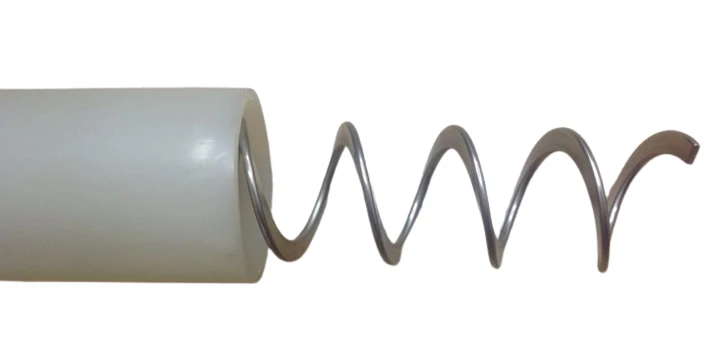
The spiral is the main moving element that advances material through the tube. “One moving part” describes the conveying element; it does not mean the motor, gearbox or any auxiliary feeding equipment has no moving components.
With few moving parts, EHK offers minimal maintenance needs and long service intervals. Material is conveyed by a shaftless spiral rotating inside a closed tube. Routine checks of the tube, connections and drive are carried out as part of a maintenance plan suited to operating conditions.
On lines with material changes, the tube can be easily removed via a quick clamp and cleaned. Alternatively, safely stop the line and fit a suitable clean spare tube; the removed tube can be cleaned while the restarted line operates. This minimises cleaning downtime. Cleaning of the spiral and other product-contact surfaces must also be considered; changing only the tube does not clean the entire line. Wet cleaning, food contact and allergen compatibility are confirmed per project.
In suitable applications, EHK can be an economical alternative to other conveying methods. Compare not just device prices but also installation, auxiliary equipment, energy, cleaning and maintenance requirements.
A powder conveying system and a granule conveying line may operate under different conditions. EHK suitability is determined by examining flow behaviour, particle structure, moisture, bulk density and abrasiveness together, not by material name alone.
Examples include flour and similar powdered raw materials, feed ingredients, pellets, plastic granules and raw material additives, cement, ash and mineral powders. This list does not mean every material can be conveyed under all conditions.
Preliminary assessment is particularly important for sticky, moist, bridging, abrasive or fragile materials. Specify food-contact, temperature and hazardous-area requirements in the quotation request; suitability is confirmed separately.
Your material is not listed? Share its properties so we can assess conveying suitability.
| Industry | Potential application scenario |
|---|---|
| Cement | Transfer additives or mineral powder from a feed hopper to a preparation or mixing point. Wear and dust control requirements are assessed together. |
| Animal feed | Convey feed ingredients to the mixer feed point. For pellets, also check product integrity and sensitivity to breakage. |
| Food | Transfer flour or similar dry raw materials from a preparation hopper to production equipment. Food contact and cleaning between products guide the design. |
| Plastics | Deliver plastic granules or suitable additives to the machine feed hopper. Layout, feeding requirements and raw material changes are considered together. |
| Energy | Convey ash or suitable dry process additives from a collection/feed point to the next equipment. Suitability is not approved without verifying temperature and abrasiveness. |
| Treatment | Transfer dry chemicals from a storage or feed hopper to a preparation unit. Moisture absorption, lumping and material compatibility are assessed. |
| Insulation | Feed suitable powder or granular additives to a mixing preparation point. Light, fibrous or bridging materials require additional suitability assessment. |
Choose a requirement similar to yours. These are general scenarios; the outcomes describe design objectives.
Problem: Manual transport of powdered raw material to the mixer requires repeated lifting and open transfers.
Infomak solution: An EHK line is assessed between the feed hopper at the bag emptying point and the mixer inlet. Height difference, material flow and dust control at connections are designed together.
Effect — hedeflenen: Reduce manual intermediate transport and deliver material to the mixer along a defined, enclosed route.
Problem: Space around the hopper is limited; material must be transferred to a machine at a higher level.
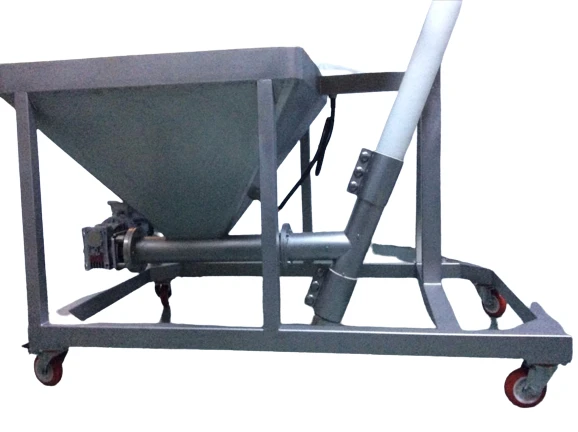
Infomak solution: A layout combining a short horizontal feed below the hopper with adjacent vertical transfer is assessed. The connection between feed and lifting sections is designed according to material behaviour and machine needs. This is not treated as a single spiral turning through a sharp elbow.
Effect — hedeflenen: Establish a granule conveying connection suited to available space and define the feasible route using site dimensions.
Problem: Dry additives must be transferred to the preparation unit; conveying and target quantity control are being treated as the same requirement.
Infomak solution: The roles of the EHK conveying line and dosing system are distinguished. If precise quantity control is required, weighing, measurement and control equipment needs are assessed separately.
Effect — hedeflenen: Transfer the additive to the preparation point and clearly define the system required for quantity control. EHK alone is not presented as a guarantee of precise dosing.
Problem: Raw material in a big bag must reach the mixer or production machine; intermediate handling and open transfers complicate feeding.
Infomak solution: The big bag unloading station outlet connects to the EHK inlet to form an enclosed feeding line to the mixer or machine. Material discharge behaviour, station connection, route and receiving equipment needs are assessed together. The scope of the unloading station and auxiliary equipment is defined during quotation.
Effect — hedeflenen: Transfer raw material from big bag unloading to the process along an enclosed route, reducing intermediate transport and open transfer points.
We review material and plant layout together. Six information groups form the starting point for configuration.
Flow behavior, bulk density, moisture, grain structure and abrasiveness.
Target flow and continuous or intermittent operation.
Horizontal distance, elevation, incline and existing equipment.
Diameter, geometry and product-contact materials.
Hopper selection, big-bag connection and receiving equipment conditions.
Cleaning method, service access and control integration.
Target capacity and operating mode
Preselection of Ø63, Ø90 or Ø125 outer tube
Horizontal distance, vertical rise and total route
Incline, bends and position of steep sections
Materials of product-contact parts
Hopper, inlet and discharge connections
Drive and control requirements
Infomak Mekatronik designs its own EHK systems around your plant's material and layout conditions. Feed point, conveying route and process connections are assessed within the same project.
Our industrial measurement and process experience focuses not only on the conveying line, but also on the equipment feeding it and receiving material from it. The aim is to integrate EHK suitably into your production flow.
Contact the Infomak team directly for technical assessment and site implementation needs. Layout review, installation and commissioning support are scoped during quotation.
The quick-clamp tube is easily removed for cleaning. To minimise downtime, fit a clean spare tube and restart the line while the removed tube is cleaned separately. Removal and installation require safe power isolation and prevention of restart. The spiral and other contact surfaces are also part of the cleaning plan. Wet cleaning, food contact and allergen compatibility are confirmed per project.
Suitability is assessed separately for each material. The quick-clamp tube is easily removed and cleaned or replaced with a clean spare. After safe replacement and required checks, the removed tube can be cleaned while the line operates, helping minimise downtime. Residues, cross-contamination and allergen risks extend beyond the tube to the spiral, hopper and other contact surfaces. Wet cleaning, food contact and allergen compatibility are confirmed per project; a tube change alone does not guarantee allergen-free changeover.
Inclined and suitably curved routes can be assessed. Feasible incline and bending conditions depend on material and configuration; not every turn or vertical conveying request is automatically suitable. Inlet/outlet heights and a layout drawing are required for selection.
Target capacity is assessed together with bulk density, particle structure, flow behaviour, feed arrangement, diameter, distance and incline. The same conveyor may not deliver the same mass throughput for different materials. Selection is verified with sample tests where necessary.
With few moving parts, EHK offers minimal maintenance needs and long service intervals. Material is conveyed by a shaftless spiral rotating inside a closed tube. Routine checks of the tube, connections and drive are carried out as part of a maintenance plan suited to operating conditions.
EHK can serve as the conveying or feeding section of a dosing system. If a specific quantity or accuracy is required, measurement, weighing and control requirements are defined separately. Conveying capacity alone does not mean dosing accuracy.
Share the material name, target capacity and inlet/outlet positions. You can attach plant photos or a simple drawing. If technical values are not yet known, a description of your needs is enough.
Explore factors affecting EHK capacity →