

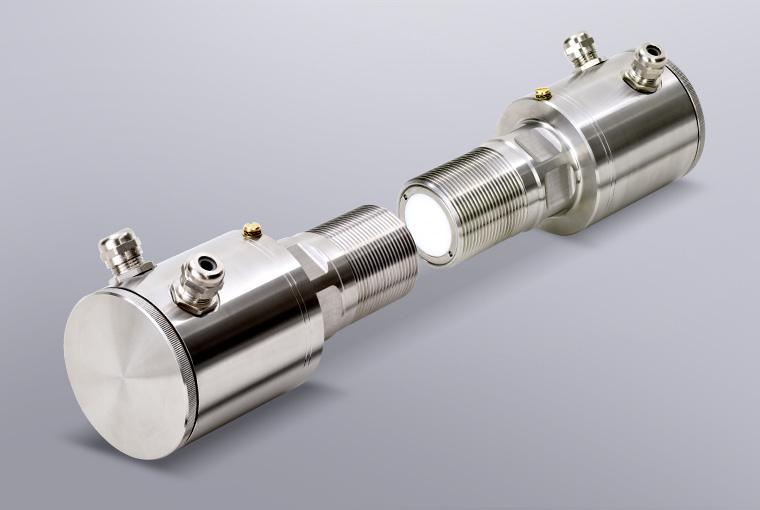
Material attenuation of the microwave signal between transmitter and receiver is converted into a switching signal. Besides level limits, it can support blockage monitoring, counting and position control.
Non-contact detection between transmitter and receiver
The receiver evaluates the opposing transmitter's microwave signal. Attenuation by intervening material triggers switching. Besides level and blockage monitoring, suitable installations can support counting or position detection.
Detection through plastic, glass or an electrically non-conductive window is possible after verifying its construction and process conditions. Check alignment and signal effects from intervening structures during installation.
Difference between flow monitoring and point level detection
LC 510M evaluates microwave attenuation by material between transmitter and receiver. Accumulated material can trigger the level limit. This differs from the motion-detecting FS 510M.
Technical documents
LevelCheck LC 510M · Manufacturer brochure (EN · 2 pages)Download document ↓LevelCheck LC 510M · Technical document (EN · 19 pages)Download document ↓When is it suitable?
For full/empty or blockage information without product contact.
Technical selection and configuration
| Measuring principle | Transmitter / receiver microwave barrier |
| Settings | Sensitivity, hysteresis and filter time |
| Measurement | Non-contact; possible through a suitable insulating wall |
Confirm numeric limits and connection options against the current manufacturer datasheet and exact order code.
Installation notes
Position transmitter and receiver opposite each other with a clear signal path across the measurement section. Check insulating window/wall selection and buildup effects with the process.
ATEX and certificates
For certified versions, check the full device type code, marking and manufacturer documentation together.