
Six information groups are needed to select a flexible screw conveyor: material, target capacity, route, inlet and discharge equipment, cleaning and plant conditions. Choose tube diameter and motor after these are known.
Quick response
- A material name alone is insufficient for selection.
- Measure horizontal distance and vertical rise separately.
- State capacity with units and operating mode together.
- Do not guess unknown values; mark them clearly.
Tap a heading to see why the information is needed.
Material
Determines flow behavior and trial needs.
Start with what you know
You may attach a drawing or photo and leave unknown technical fields blank.
What information is needed to select a flexible screw conveyor?
| Topic | Information to provide |
| Material | Name, bulk density, particle size, moisture, temperature and flow behavior |
| Target | Capacity and unit; continuous, intermittent or batch operation |
| Route | Horizontal distance, vertical height, total route, bends and vertical section |
| Connections | Feed equipment, inlet, discharge point and receiving equipment |
| Cleaning | Product count, change frequency, cross-contamination and contact material |
| Plant | Environment, power and control needs; zone classification if applicable |
Bulk density, particle properties and moisture affect conveying behaviour. Report any observed adhesion, bridging, breakage or hardening while standing. If the product is insufficiently known, consider testing a representative sample.
Capacity is more than a kg/h figure. Specify continuous or intermittent operation, the time available to transfer a batch and daily operating hours. EHK is transfer equipment; define separate measurement and control requirements if verified weighing or precise dosing is expected.
How should the route be described?
Give horizontal distance and vertical rise from inlet to outlet separately. Show bend directions, location of steep sections, maintenance space and inlet/outlet elevations on a simple sketch. A single figure such as “eight metres total” does not describe the route geometry.
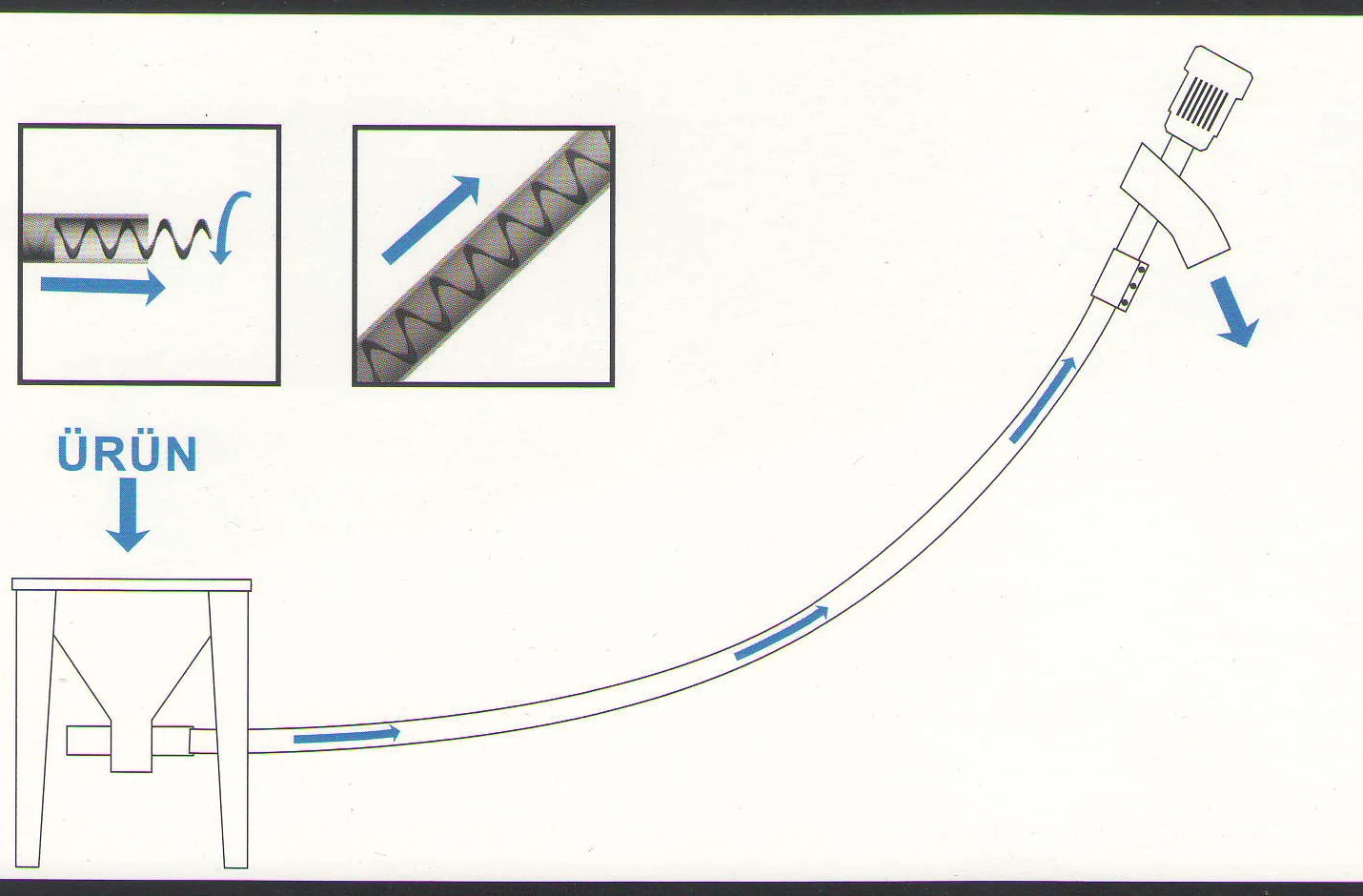
Bag-dump hoppers, big-bag stations, silos and machine outlets have different feed conditions. Also state whether the receiving mixer, hopper or production machine accepts material freely at the discharge.
Why ask about cleaning and plant conditions at the outset?
If there are several recipes, food contact or cross-contamination limits, the changeover method is a design input. Space for disassembly and cleaning must be planned from the start.
State power supply, start/stop logic, level signals and other process interlocks. Where combustible dust poses a risk, base the final decision on the equipment nameplate, certificate and plant explosion protection document.
Common selection mistakes
The same product can behave differently with moisture and grain structure.
Show horizontal, vertical and curved sections separately.
kg/h, batch quantity and operating time are different information.
Product change and cross-contamination can affect design.
Applications that are straightforward or need extra attention
Speeds up assessment
- Simple dimensioned sketch
- Photos of inlet and discharge
- Representative material details
- Capacity and operating time
Needs additional checks
- Material behaviour unknown
- Bridging or adhesion
- Route with many bends or steep rise
- Frequent product changes
Frequently asked questions
Must I know every technical value for an EHK quotation?
No. Do not guess unknown values. Start with material, task and inlet/outlet points; complete missing details during technical assessment.
Is total conveying distance enough?
No. Show horizontal distance, vertical height, bends and vertical-section location separately. A simple dimensioned sketch or photo speeds assessment.
Can one EHK convey multiple products?
Possibly; assess each product's flow and cleaning separately. Specify changeover, cross-contamination and cleaning before quotation.
Why does the selection form ask about ATEX?
In combustible-dust plants, zone classification and equipment requirements are project inputs. Verify selection using nameplate, certificate scope and the plant explosion-protection document.
Start EHK preselection
Add the information you have and any plant images to the short form.
Go to the application form