
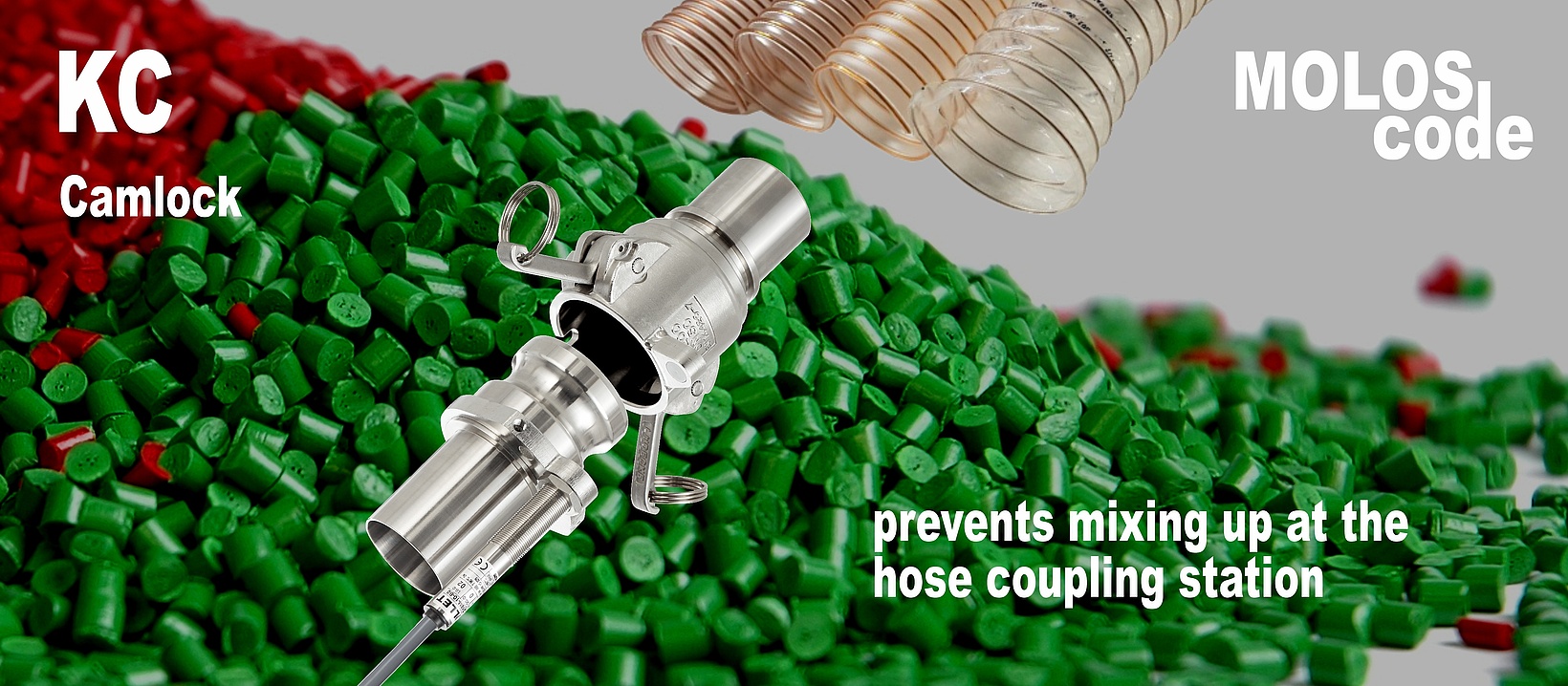
MOLOScode coupling application; this is not a product image of the BUS distributor.
Is the hose on the correct line, is the connection complete, and is material actually flowing? These are separate questions. RFID identifies the hose, a connection switch reports the mechanical connection, and a flow monitor detects material movement.
Understand the operating principle visually
Diagrams explain the principle; they are not scaled installation or electrical wiring drawings.
1 · Hose identity
The MOLOScode reader and RFID tag identify the hose. The PLC checks source and destination matching; RFID does not measure material flow.
2 · Mechanical connection
MOLOSswitch / MOLOSswing report connection status. Consider MOLOSlock separately if locking is needed; identity and connection are separate signals.
3 · Material movement
MOLOSflow FSM51 monitors material movement in the line. Flow presence is not inferred from hose identity or the connection signal.
Filling permission in the PLC
Correct source–destination + connection complete + level acceptable + pressure acceptable → filling permission. Once flow starts, monitor the movement signal separately.
Match the task to the requirement
| Question | Solution |
| Correct hose and destination? | MOLOScode KC · RFID |
| Is the hose connected? | MOLOSswitch / MOLOSswing |
| Is material moving? | MOLOSflow FSM51 |
| Is the connection locked? | MOLOSlock |
Combine them in the filling permission
Assess correct source/destination, connection, silo level and pressure together in the PLC logic. Do not infer that flow has started from an RFID signal; add independent flow monitoring where required.