
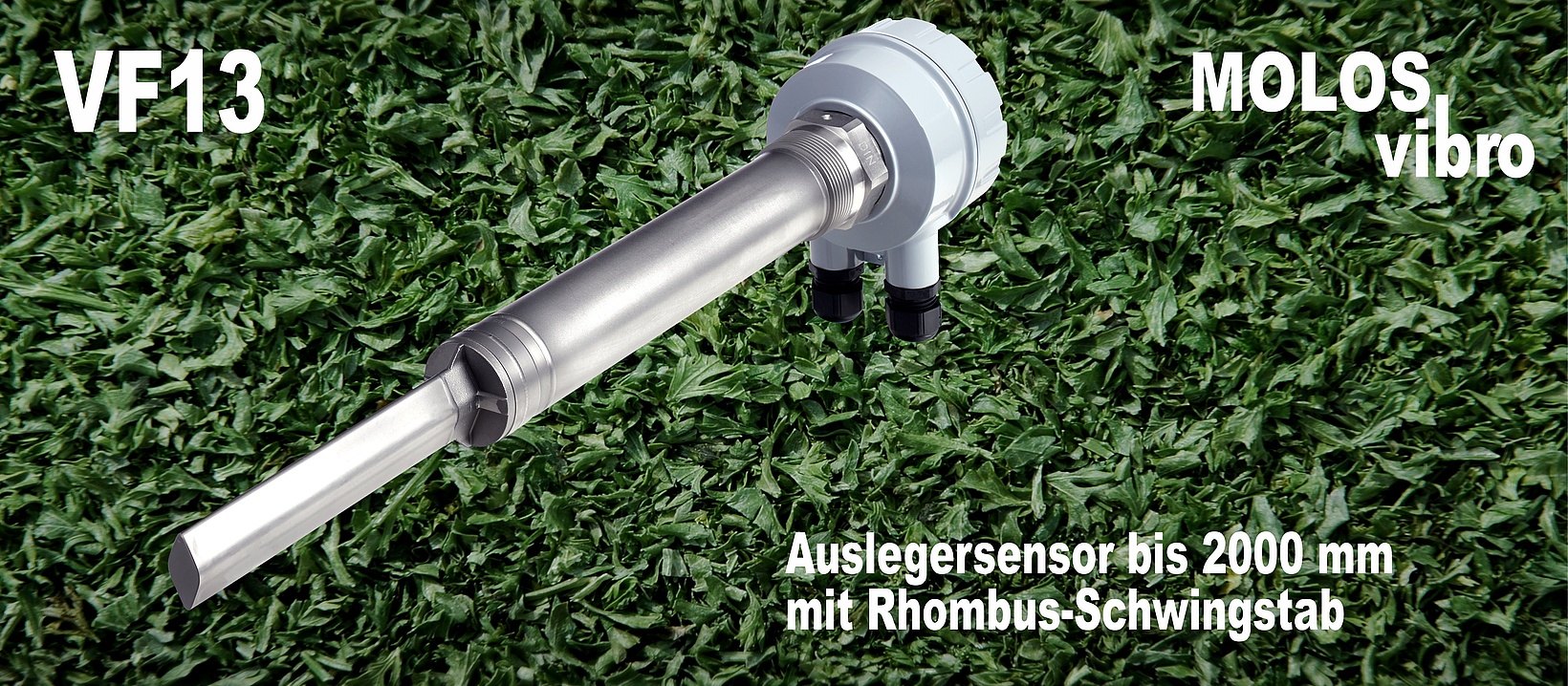
VF is a point-level switch. Material contact changes the vibration of a single rod; the output reports a full or empty point. It does not measure continuous silo level or mass flow.
For VF1, bulk density must exceed 20 kg/m³ with S0 or 10 kg/m³ with SE. For VF6, S0 requires more than 20 kg/m³; SA is a special option for material settling in water. VF1 high sensitivity is not the same option as VF6 SA.
Understand the operating principle visually
Diagrams explain the principle; they are not scaled installation or electrical wiring drawings.
1 · Rod uncovered
Without material contact, the rod vibrates freely. The sensor detects an uncovered measuring point.
2 · Material contacts the rod
Material changes the vibration. The output indicates a covered measuring point; it does not provide a continuous level value.
3 · Choose the mounting point
Consider a compact side-mounted rod or a rigid or cable extension from above. Protect the rod from the filling stream and mechanical loads; install cable probes from above.
Model selection by probe construction
Then check bulk density, probe length and Ex requirements. VF1 and VF6 sensitivity options differ; complete the detailed selection in the configurator.
Open the VF configurator →Probe design and catalogue lengths
| Model | Design | Length selection |
| VF12 / VF62 | Compact single rod / mini rod | Fixed compact probe |
| VF13 | Rigid extension | 200–2.000 mm · 100 mm |
| VF15 | Cable probe | 500–8.000 mm · 100 mm |
| VF63 | Rigid mini-probe extension | 300–1.000 mm · 100 mm |
| VF65 | Cable-suspended mini probe | 500–4.000 mm · 100 mm |
Required unit for gas and dust Ex selection
The B11 gas and dust option uses C5i 23.7 V DC and the external VF-VEC8-B22 unit. This differs electrically from the C8 wide-range relay supply. Confirm Ex temperature and installation suitability using the complete code and certificate.
Installation checks
Assess free rod vibration, protection from the filling stream and build-up. The 20 m statement for VF15 applies only to special interface measurement; it is not the standard solids-level length range.