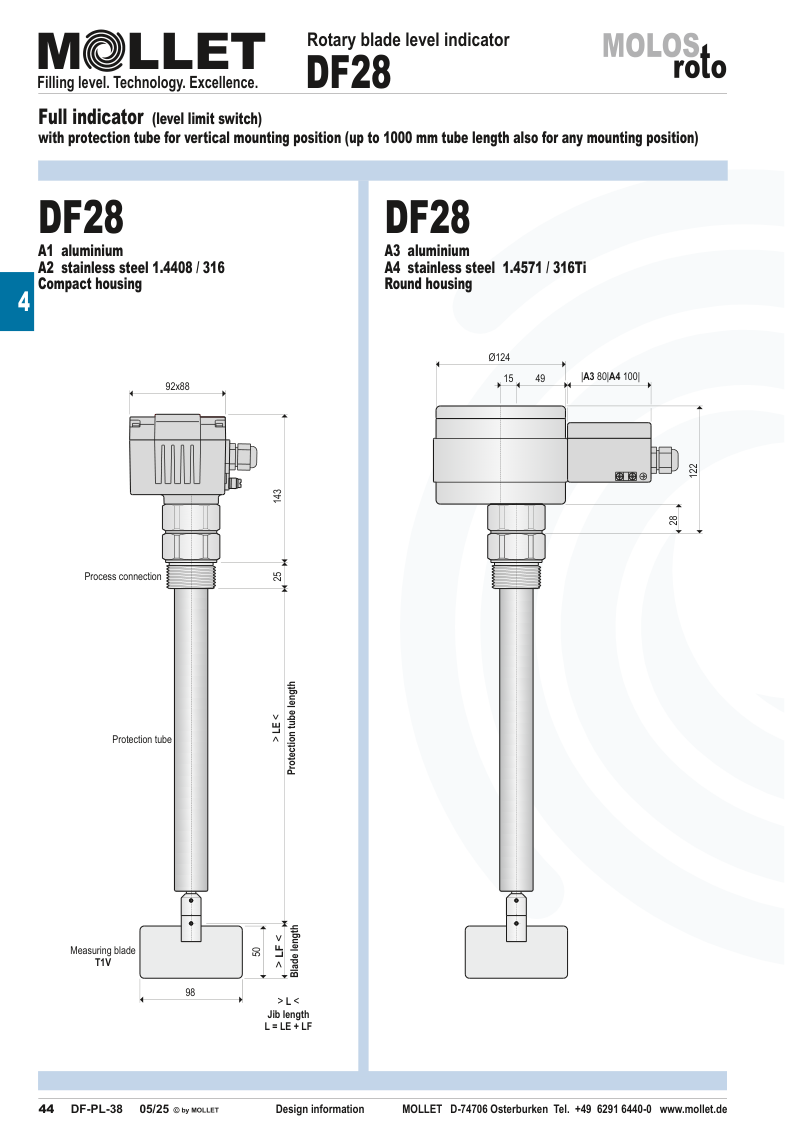
Example configuration. Appearance varies with your choice of housing, connection and paddle.
TECHNICAL SELECTION
For your application: DF28 configuration
Specify the supply voltage and process conditions. Available options update with your selections; review the preliminary order code and technical summary on the same screen.
Housing and ATEX option
?
The housing contains the motor and electrical connections. Aluminium or stainless steel is available. A certificate suffix starting with B identifies explosion protection and must match your plant’s dust/gas zone. B2 is only available with D1 or D2 monitoring. Special conditions in the explosion protection certificate also apply for Zone 20 (II 1D).
Property selected in this step
Motor/connection housing and ATEX certification if needed.
Selection criteria
Without hazardous atmosphere, choose A1 or A2 only. Round housings are available only as A3B1/A3CB1 or A4B1/A4CB1/A4CB2 certified codes.
Add application notes or drawing details
DF28 operating principle
With its protective tube design, DF28 is used particularly for full-level detection from above. Tube length, mounting direction and mechanical loads during filling are assessed together. Options such as HVP level adjustment and SD1V paddle protection are considered for the application.
Full level
Indicates a full condition when material reaches the upper detection point. This signal can be used by the plant’s filling control system.
Technical specifications and options
Operating limits differ between standard, optional and ATEX-certified versions. Evaluate the following values together with your chosen housing and options.
Detection
Point full-level detection
Mechanical design
Shaft with protective tube
Tube length
Up to 6,000 mm in the catalogue family; configuration dependent
Installation
Vertical mounting; horizontal mounting possible with KD end bearing and sealing ring option
Temperature options
E1: 150 °C; E2: 200 °C; E3: 260 °C; E4: up to 500 °C
Level adjustment
HVP8 / HVP9; different dust and pressure conditions
Paddle protection
SD1V protective roof; separate mechanical configuration
Selection table source: MOLLET DF technical selection catalogue, DF28 p.44–49. Current manufacturer options and special designs are confirmed during quotation.
ATEX and certification selection
Ex suitability cannot be determined from the model name. Verify the certificate scope and special conditions of use together for the dust/gas zone, housing, process connection and selected options.
Considered where a defined sensing level must be reached from the silo roof. The standard model drawing specifies vertical mounting and other mounting positions for tube lengths up to 1,000 mm; specially protected configurations require separate verification.
Material: Consider bulk density, particle structure, adhesion and buildup when selecting the measuring paddle.
Installation position: Check that the paddle rotates freely, passes through the connection opening and is protected from the filling stream.
Installation dimensions: Show the process connection, detection point and model-specific lengths on a dimensioned drawing.
Process and electrical data: Specify operating temperature/pressure, supply voltage and the hazardous area classification, if applicable.
Vertical mounting is standard. For horizontal mounting, use the KD bearing and sealing ring option at the protective tube end; verify the exact arrangement against the manufacturer's drawing. Assess loads from the filling stream on paddle and protective tube. HVP9 is specified only for dust-free, unpressurized operation. HVP8 pressure and temperature limits must not be taken as the limits of the complete device. Keep the thermal separation section clean and uninsulated.
Need a different mechanical design?
Consider other MOLOSroto models if your application requires a protective tube, reinforced shaft, angled extension or suspended cable.
Vertical mounting is standard. Horizontal mounting uses the KD bearing and sealing ring option at the protective tube end; verify tube length, mechanical loading and exact arrangement against the manufacturer's drawing.
Can HVP8 and HVP9 be used for the same purpose?
Both adjust the level setting but have different operating conditions. HVP9 is specified for dust-free, unpressurized operation; HVP8 for dusttight and pressure-tight operation within its stated limits.
Let us assess your application
Share material data, installation drawings and process conditions. Once you have completed your configuration, use “Request a quote with this selection” in the configurator.