

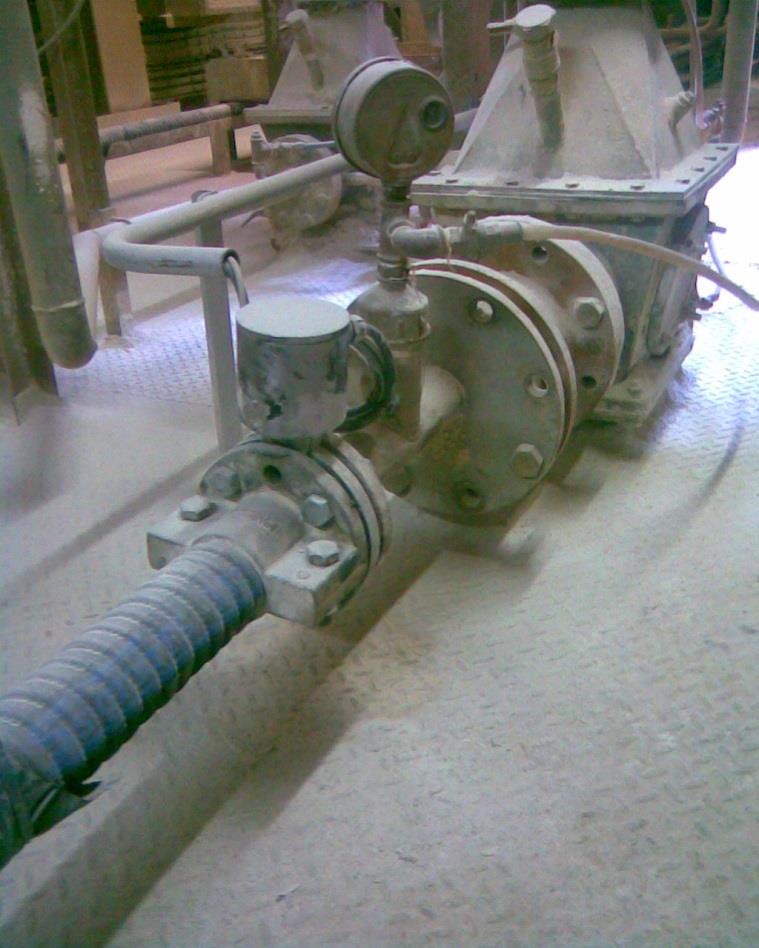
Source: field photograph from DYNA Instruments application document APP-24.
This is a manufacturer application example published by DYNA Instruments; it is not presented as a project carried out by Infomak.
In cement production, delivering the additive to the intended point is important for mixture consistency. DYNA's published application example for Ciments Calcia focuses on detecting blockages in an iron sulphate dosing line.
| Industry | Cement |
| Material | Iron sulphate |
| Process | Pneumatic additive feed / dosing |
Problem and measurement challenge
The aim was to detect blockages without delay in an iron sulphate feed operating at 120–280 kg/h. Movement of the rotary valve near the measuring point was also taken into account.
Technology selection
Four DYNAguard K DN65 units with relay outputs were used. The system monitors material movement to help detect blockages. The flow stated in the document is the process operating range; it does not mean that this relay-based installation measures mass flow.
Installation and technical notes
The sensors were installed in the pneumatic iron sulphate feed line near the rotary valve. The manufacturer reports that the valve's rotation did not affect detection in this application. Installation geometry and normal feed intervals must be reassessed for another line.
Do you have a similar application?
Share your material, capacity range, conveying method and a photo of the installation point so we can assess the appropriate sensor and measuring location together.
Request a quote for this application →Sources
DYNA Instruments · APP-24 · Original application document (English PDF) ↗
Does every interruption in flow indicate a blockage?
No. Scheduled dosing stops and depletion of material can also interrupt flow. Alarm logic must be designed together with the feed command and normal process cycle.