
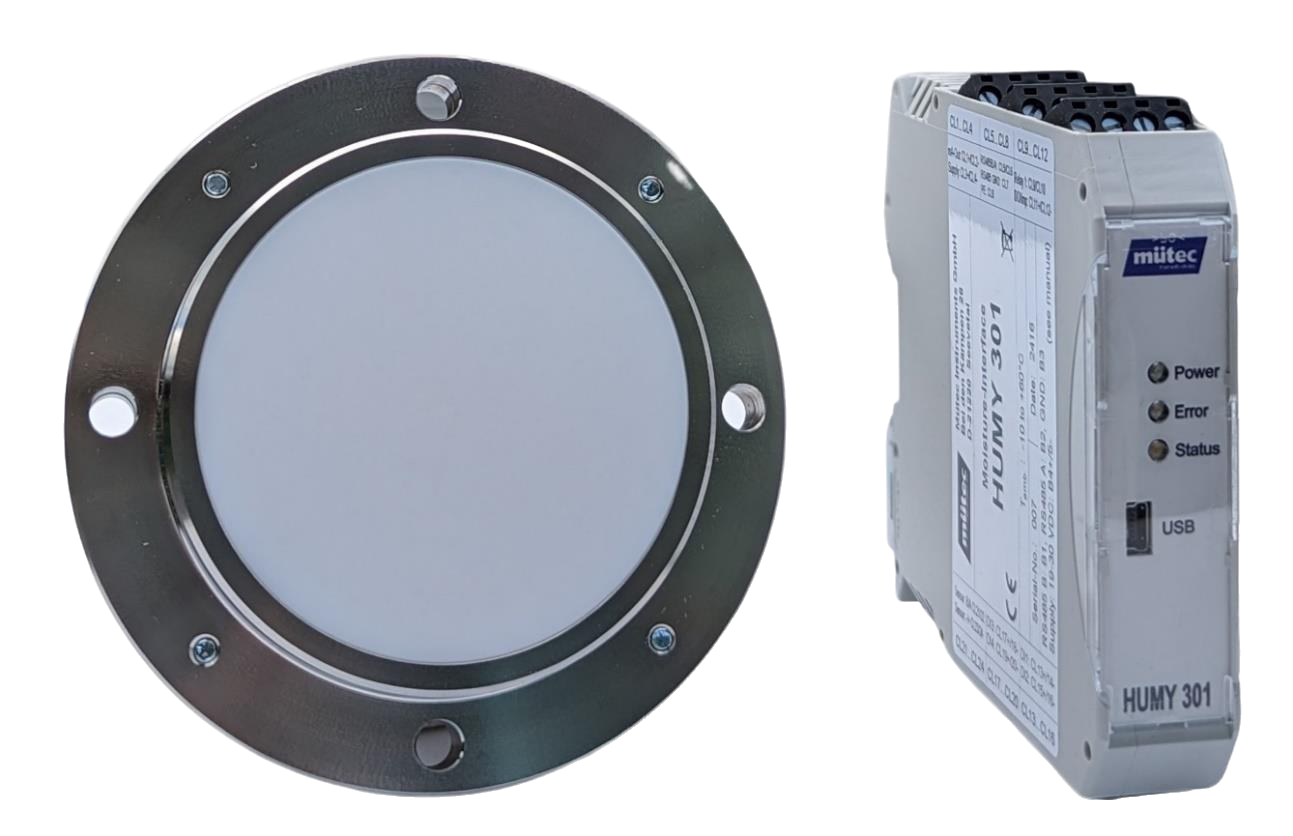
MÜTEC HUMY 301 product image; not a field photo of a specific plastics application.
Inline moisture measurement in plastic granules tracks changes in material entering production. Before sensor selection, define polymer type, target moisture range and the production decision the measurement should support.
This guide combines the manufacturer's published plastic-granule application report with technical selection questions. Plants in that report are not presented as Infomak customer references.
What does the manufacturer's plastic-granule report show?
The MÜTEC report dated 16.02.2024 illustrates moisture monitoring in a hopper before an extruder. It stresses stable conditions around 0.05–0.1% moisture. Measurement may use moving product or triggered readings with conditions such as fill level held constant.
The report states that very dry material after a dryer, for example 0.02–0.05%, cannot be measured with this application. Do not assume suitability for low-ppm dryer-outlet targets. Its 0.1% process threshold is not universal for all polymers.
Percentage, ppm and accuracy are different
| Moisture content | Mass-based equivalent |
| %0,1 | 1.000 ppm |
| %0,05 | 500 ppm |
| %0,02 | 200 ppm |
Conversion applies when percentage and ppm use the same mass basis: 1% = 10,000 ppm. For example, 200 ppm is 0.02%. This does not prove the device can reliably measure that level.
Catalogue accuracy is not the same as the lower measurement limit, resolution or error achieved in every polymer. Specify target moisture and acceptable deviation separately.
What should be checked at each point?
| Point | Technical assessment |
| Hopper before the extruder | Stable product coverage, flow and nearby sampling point |
| Dryer outlet | Target moisture measurability and temperature within sensor limits |
| Pneumatic transfer | Effect of intermittent product passage and air gaps on representativeness |
| Rapidly emptying hopper | Changing fill level and bulk density |
The report notes fluctuation risk from density changes during rapid emptying. Do not select a location solely because the sensor fits; define the operating phase in which measurement is valid.
Calibration and laboratory comparison
The plastics report requires in-process calibration with the sensor installed; it does not recommend static calibration with a removed sensor. Use moisture points representing the operating range.
Fix sampling time, sealed transport container, waiting time and reference method in the commissioning plan. Check laboratory-method suitability and repeatability for the target range. One matching result does not validate the whole range.
Do not assume the same curve remains valid after polymer, filler, color or recipe changes. Assess new conditions with control samples. Use samples excluded from calibration for independent comparison.
HUMY 301 or HUMY 3000?
First assess material and moisture-range suitability. Then consider PLC/software integration for HUMY 301 and local display/system configuration for HUMY 3000. Selecting a display unit does not automatically change low-moisture measurement limits.
Information for technical review
| Information | Required detail |
| Material | Polymer type, filler/additive, granule size and recipe count |
| Moisture target | Minimum / normal / maximum; % or ppm and acceptable deviation |
| Process | Before/after dryer, temperature, fill and flow continuity |
| Installation | Hopper section, photo, sampling and maintenance access |
| Reference | Laboratory method and simultaneous sampling capability |
| Automation | PLC, analog output/Modbus, local display and logging needs |
Technical documents
| Industry | Plastics |
| Material | Plastic granules |
| Process | Storage / transfer → feed hopper → extruder |
Problem and measurement challenge
Effects of product contact, temperature and density changes at low moisture levels.
Technology selection
First verify target moisture-range suitability, then sensor surface, mounting and control-system connection.
Installation and technical notes
Examine product movement and fill at the measuring point. Synchronize sampling with measurement.
Is your granule and target moisture range suitable?
Share the material, moisture target and measuring point so we can assess application suitability first.
Moisture measurement application form →Request a quote for this application →Sources
MÜTEC plastic granule application report · 16.02.2024 · EN PDF ↗
Can HUMY measure 200 ppm moisture at a dryer outlet?
200 ppm equals 0.02% by mass. The manufacturer's plastic-granule report excludes very dry material, for example 0.02–0.05%, from this application. Do not assume suitability for this target; assess another measurement approach.
Can one calibration be used for all plastic granules?
Polymer and recipe changes can affect sensor response. Verify calibration validity for each product group with reference samples.