

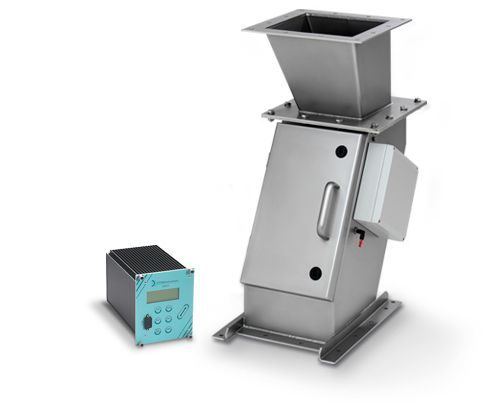
Product flows over a weighing chute. The weight measured by the load cell and non-contact velocity measurement are combined to calculate mass flow.
The system has no moving measuring parts. The manufacturer brochure describes a principle requiring no product-specific calibration; site suitability, installation and operating range must still be verified.
Weighing and velocity measurement combined
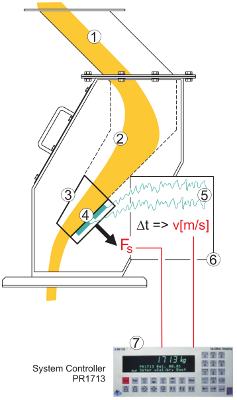
Product flows through the inlet and calming section onto the measuring chute. The load cell measures weight force perpendicular to the chute. Two sensors on the chute detect electrical particle signals; their time difference yields product velocity. Product mass and velocity together yield mass flow.
The measuring principle requires no product-specific material calibration. Installation, zero adjustment and verification of site performance remain part of commissioning.
Free-fall and dosing applications
The current DYNAchute version is for free fall and is not offered for pneumatic conveying lines. Check vertical alignment, vibration protection, inlet geometry and available installation height.
Considered for continuous kg/h measurement, dosing control or batch quantity monitoring. Product continues to pass freely through the chute during power failure. DYNAcon configures the measurement display, limits and suitable control outputs.
Basis for technical values
The numerical values on this card are based on the downloadable manufacturer document GB03. Process and ambient limits are assessed together for the standard or optional version ordered.
Free fall, vibration and dust
Plan a vertical, vibration-free, free-fall installation for DYNAchute. It is not directly applicable to pneumatic conveying lines. The GB03 datasheet also specifies purge air for very dusty materials; assess product behavior on the chute and cleaning requirements.
Technical documents
DYNAchute technical brochure · English PDFDownload document ↓Catalogue drawings
DYNAchute operating principle
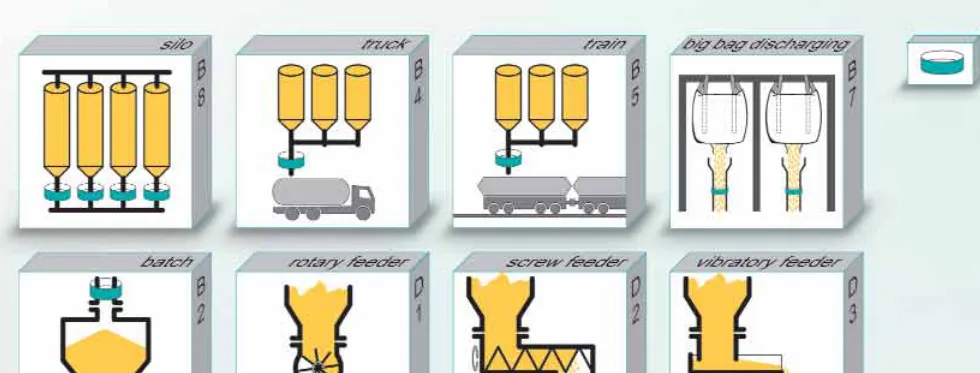
When is it suitable?
When continuous product quantity measurement is needed in a free-fall line and space can be provided for a weighing chute.
Technical selection and configuration
| Size 250 | 0.2–20 t/h; 0.4–35 m³/h |
| Size 400 | 2.5–50 t/h; 5–100 m³/h |
| Stated accuracy | Up to 0.2% of full scale; application-dependent |
| Measuring principle | Load-cell weighing + product velocity by correlation |
| Material | Stainless steel 1.4301; ceramic measuring chute |
| Pressure rating | 0,1 bar |
| Temperature | Process +10…+40°C; ambient −15…+50°C |
| Protection | IP64 |
| Purge air | For very dusty products: 2 bar / 0.6 Nm³/h |
| Installation | Vertical and vibration-free |
Confirm numeric limits and connection options against the current manufacturer datasheet and exact order code.
Installation notes
Plan vertical, vibration-protected installation and sufficient inlet length. Consider a purge-air connection for very dusty products.
ATEX and certificates
Assess the Ex zone and certification requirements together with manufacturer documentation for the selected variant. The product family name alone does not establish ATEX suitability.
What information is needed to select DYNAchute?
Provide minimum/normal/maximum flow, product name and bulk density, particle size, available installation height, inlet/outlet dimensions and vibration conditions. Confirm free-fall operation and whether continuous measurement or batch dosing is required.