
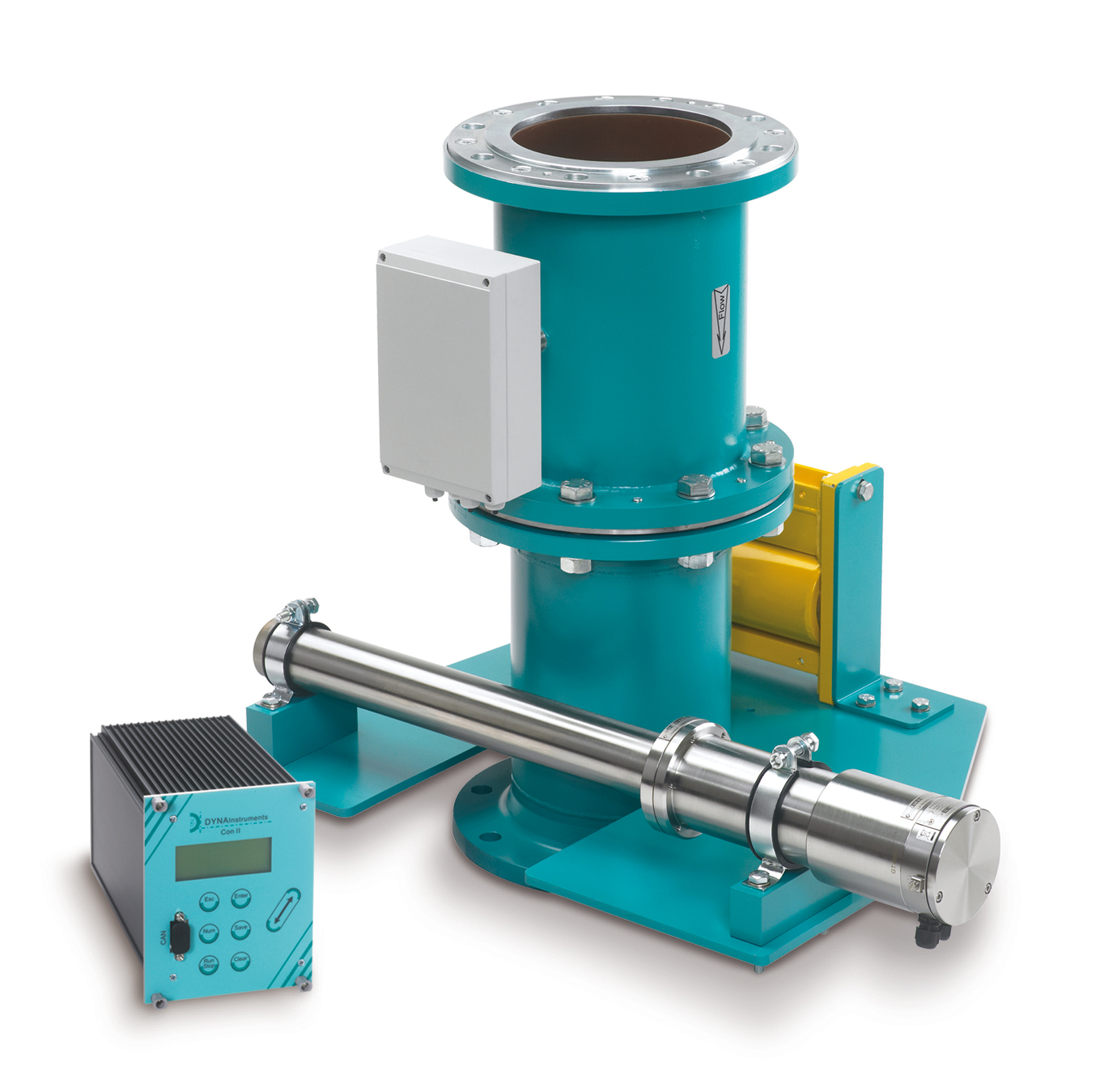
DYNArad measures product concentration radiometrically by gamma transmission and solids velocity with DYNAvel. Concentration, velocity and pipe cross-section are combined to calculate mass flow.
Both measurements are performed without contacting the product flow. The system is designed for stable measurement in demanding applications with changing density, particle size, moisture, friction behavior, process pressure and conveying velocity.
Radiometric concentration measurement uses Berthold Technologies equipment. Source, detector, shielding and site safety are planned with authorized specialists as part of the project.
How are density and velocity measured together?
Gamma radiation from the shielded source is attenuated according to material concentration as it passes through the pipe. The scintillation detector opposite measures this attenuation to determine concentration in kg/m³.
DYNAvel uses correlation to evaluate transit time between two sensors and measure actual product velocity in m/s. The controller combines concentration, velocity and pipe area to produce kg/s or t/h.
For which applications is it considered?
| Application | Information provided by DYNArad |
| Fly ash conditioning | Continuous high-capacity t/h measurement and feedback for water dosing |
| Pneumatic conveying | Mass flow with changing product density and velocity |
| Truck loading | Monitoring total quantity during loading |
| Dense-phase conveying | Non-contact measurement in high-pressure lines |
| Free fall | Continuous quantity monitoring without restricting flow |
Differences between DYNA mass flow systems
| System | Measurement approach | Key application condition |
| DYNA M-flow / MÜTEC MF3001 | Microwave Doppler | Measurement in metal pipes with a compact probe |
| DYNAmas | Capacitive concentration + velocity | Inline measurement across different pipe diameters |
| DYNArad | Radiometric concentration + DYNAvel | Demanding processes up to 500 t/h and 64 bar |
| DYNAchute | Weighing chute + velocity | Vertical free fall |
Radiometric system planning
DYNArad selection requires more than pipe diameter and flow range. Measurement geometry, source activity, detector placement, site access and radiation safety are designed together.
Installation, operation and periodic checks must comply with the regulations and authorized-body requirements applicable to the country and plant. The final system scope is determined after technical and administrative compliance checks.
Technical documents
DYNArad product brochure · EnglishDownload document ↓When is it suitable?
Considered for highly accurate, non-contact mass flow measurement in DN100–DN400 lines despite changing product properties and process conditions, especially at high capacities or pressures.
Technical selection and configuration
| Measuring principle | Radiometric concentration + non-contact DYNAvel velocity measurement |
| Mass flow calculation | Concentration × pipe cross-section × product velocity |
| Nominal diameter | DN100–DN400; DIN or ANSI flange |
| Product velocity | 2–30 m/s |
| Concentration | 50–1.000 kg/m³ |
| Mass flow rate | Up to 500 t/h |
| Typical accuracy | Approximately 1% of full scale |
| Conveying | Pneumatic conveying / free fall |
| Installation position | Any installation position |
| Process temperature | −20…+120 °C |
| Ambient temperature | −20…+70 °C |
| Pressure | Up to 64 bar |
| Protection rating | IP67 |
Confirm numeric limits and connection options against the current manufacturer datasheet and exact order code.
Installation notes
Define flange standard, pipe diameter, line pressure, temperature, velocity and concentration range. Place source and detector opposite each other and DYNAvel at a suitable distance; plan site radiation safety during project design.
ATEX and certificates
Procurement, transport, installation and operation of the radiometric source are subject to applicable regulations and authorized-body requirements. Pressure class, materials and certificates are verified for the exact project configuration.
Does DYNArad contact the product?
Density and velocity are measured without contacting the product flow; the measuring body is a pressure-bearing mechanical part of the process line.
Why use radiometric measurement?
Gamma transmission measures concentration largely independently of changes in temperature, pressure, dust, color, conductivity and chemical properties.
What information is needed for a quotation?
Provide material, minimum/normal/maximum t/h, product velocity and density, DN and flange standard, temperature, pressure, line layout, installation space and the plant's radiometric-system requirements.