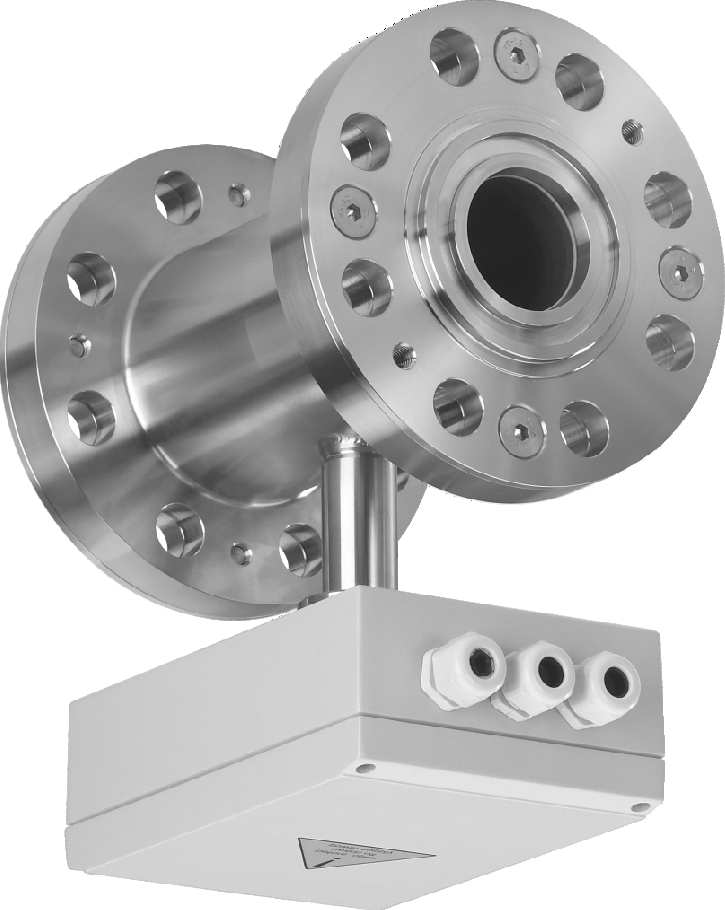
DYNAvel measures the velocity of dust, powders and granules in pipes. Correlation calculates the time difference between signals from two sensors; the known sensor spacing yields velocity in m/s.
Velocity measurement requires no material-specific calibration. Installation, parameters and signal suitability are still assessed under process conditions. Stationary particles are not detected.
Where can velocity data be used?
| Purpose | DYNAvel's contribution |
| Optimizing conveying air | Supports control-system settings by monitoring actual solids velocity. |
| Product protection | Helps assess breakage and product degradation caused by excessive velocity. |
| Wear monitoring | Supports settings to reduce wear in pipes and bends by monitoring conveying velocity. |
| Mass flow calculation | Assessed together with additional concentration measurement and appropriate calculation configuration. |
Display and automation transfer with DYNAcon
The DF series transmits measurements to DYNAcon via CAN-Bus. DYNAcon provides velocity display, parameter settings, limit monitoring and analog output depending on configuration.
The product brochure lists CAN-Bus, RS485 and Ethernet, current outputs and relays for DYNAcon. Direct sensor outputs and controller interfaces depend on the exact system configuration.
Scope of technical documents
The table above is based on the DF datasheet. The general brochure gives some different supply, ambient-temperature and protection values; maximum values from different versions must not be combined into one device specification. Select flange pressure class, diameter and process conditions together.
Technical documents
DYNAvel DF series datasheet · EnglishDownload document ↓DYNAvel product brochure · EnglishDownload document ↓When is it suitable?
For monitoring actual solids velocity in pneumatic conveying or free fall and using it for process control. Alone, it is insufficient for applications requiring kg/h measurement.
Technical selection and configuration
| Measured quantity | Solids velocity · m/s |
| Measuring range | 0,2–100 m/s |
| Typical accuracy in the DF datasheet | 1% of full scale |
| Nominal diameter | DN10–DN400; according to connection table |
| Process connection | DF series: DIN flange |
| Standard process temperature | Up to +130 °C |
| Process pressure | Maximum 64 bar; depending on DN/PN combination |
| Ambient temperature · DF | −20…+70 °C |
| Protection rating · DF | IP67 |
| Supply · DF | 18–36 VDC, max. 6 W |
| Communication · DF | CAN bus, 40 kbaud; max. 1,000 m |
| Damping · DF | 1–30 seconds |
Confirm numeric limits and connection options against the current manufacturer datasheet and exact order code.
Installation notes
Assess pipe internal diameter, flange standard, DN/PN, temperature and material buildup behavior together. Products forming an electrically conductive layer through wear or adhesion on the pipe interior are unsuitable for this method.
ATEX and certificates
Ex versions depend on documentation and device configuration. Verify the required gas/dust zone and temperature class against the current device certificate.
Does DYNAvel measure air velocity?
No. It measures the actual velocity of solid particles in the pneumatic line; this must not be assumed equal to conveying gas velocity.
Does it measure mass flow on its own?
No. Its primary measurement is solids velocity in m/s. Mass flow calculation requires additional concentration measurement and appropriate system configuration.
What information should I provide for selection?
Provide material, expected solids velocity, conveying method, pipe internal diameter, DN/PN and flange standard, temperature, pressure, moisture/buildup behavior, Ex requirements and automation interface.