
The material-contacting paddle matters as much as the sensor model. It creates resistance when rotating into material to trigger the switch. Selection therefore cannot rely only on silo diameter or device appearance.
Light free-flowing powder, coarse granules and material continuously loading a side-mounted paddle behave differently. Select paddle and model together using density, particle size, flow, mounting direction and target level.
Visual paddle selection by bulk density
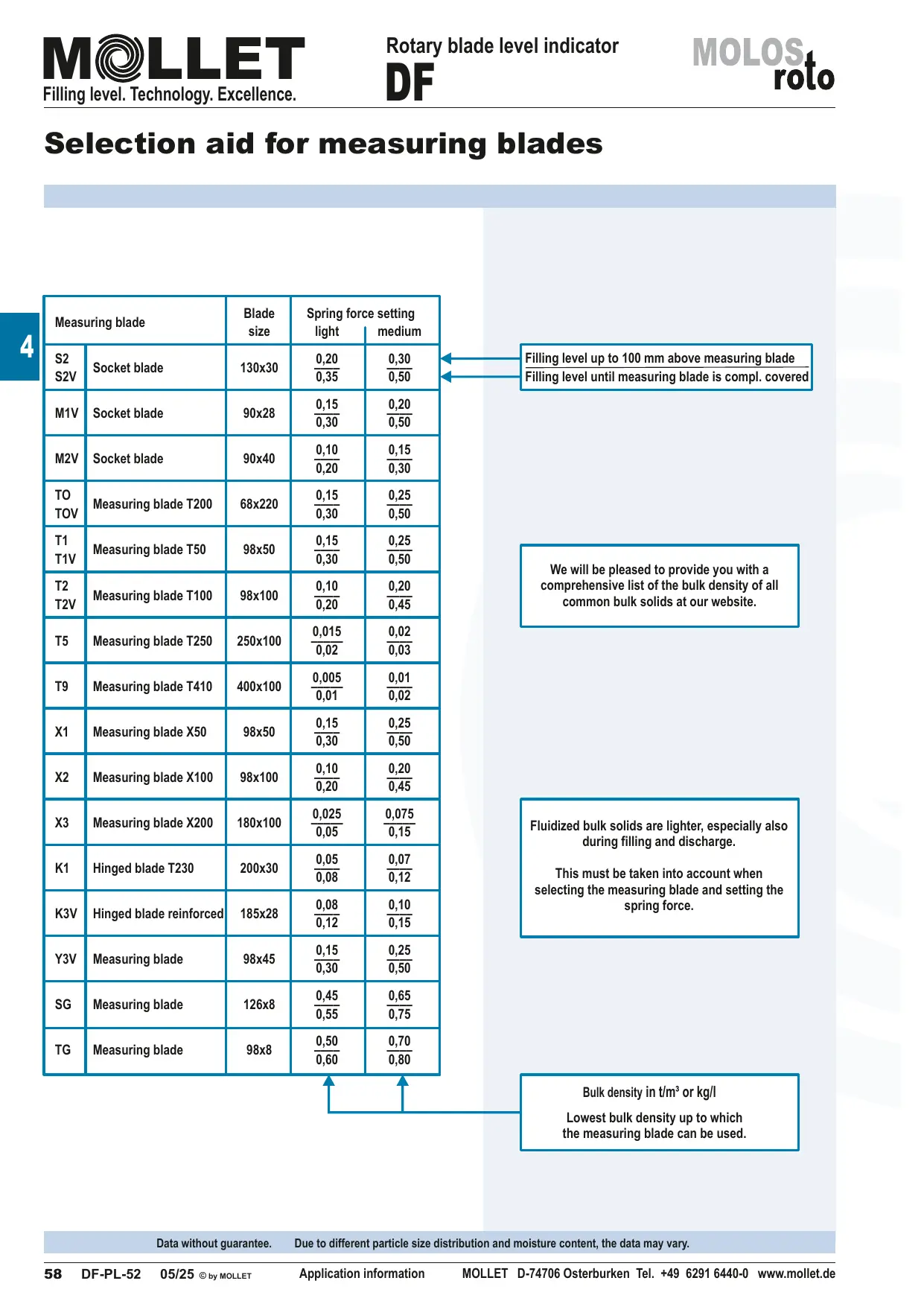
The minimum density thresholds for a fully covered paddle are used from the catalogue. This is a more conservative preselection; the catalogue also lists lower thresholds when material rises no more than 100 mm above the paddle. Results are not ranked by suitability.
Source: MOLLET 05/2025, p.58 · DF-PL-52. Values are minimum thresholds, not upper density limits.
Select a model and paddle to continue
Select a model and paddle to continue
Select a model and paddle to continue
Select a model and paddle to continue
This result is a preselection. Particle size, adhesion, flow impact, connection opening, installation orientation and wetted materials require separate checks. T6/T6V and customer-supplied paddles are excluded from automatic recommendations because no catalogue density threshold is published.
DF model–paddle compatibility matrix
| Model | Y3V | S2 | T1 | T2 | T5 | X1 | X2 | X3 | K1 | S2V | M1V | M2V | T1V | T2V | K3V | SG | TG | TO | TOV | T6 | T6V |
|---|---|---|---|---|---|---|---|---|---|---|---|---|---|---|---|---|---|---|---|---|---|
| DF21 | Yes | Yes | Yes | Yes | Yes | Yes | Yes | Yes | Yes | Yes | Yes | Yes | Yes | Yes | Yes | — | — | — | — | — | — |
| DF22 | — | Yes | Yes | Yes | — | Yes | Yes | Yes | Yes | Yes | Yes | Yes | Yes | Yes | Yes | — | — | — | — | — | — |
| DF23 | Yes | — | — | — | — | — | — | — | — | Yes | Yes | Yes | Yes | Yes | — | Yes | Yes | — | — | — | — |
| DF24 | Yes | — | — | — | — | — | — | — | — | Yes | Yes | Yes | Yes | Yes | — | Yes | Yes | — | — | — | — |
| DF245 | — | — | — | — | — | — | — | — | — | — | — | — | Yes | Yes | — | — | — | — | — | — | — |
| DF25 | — | — | Yes | Yes | — | Yes | Yes | Yes | — | — | — | — | Yes | Yes | — | — | — | — | — | — | — |
| DF257 | — | — | Yes | Yes | — | Yes | Yes | Yes | — | — | — | — | Yes | Yes | — | — | — | — | — | — | — |
| DF26 | — | — | Yes | Yes | Yes | Yes | Yes | Yes | Yes | — | — | — | Yes | Yes | Yes | — | — | Yes | Yes | — | — |
| DF27 | — | — | Yes | Yes | Yes | Yes | Yes | Yes | Yes | — | — | — | Yes | Yes | Yes | — | — | Yes | Yes | — | — |
| DF28 | Yes | Yes | Yes | Yes | Yes | Yes | Yes | Yes | Yes | Yes | Yes | Yes | Yes | Yes | Yes | — | Yes | Yes | Yes | — | — |
| DF30 | — | — | Yes | Yes | — | — | — | — | — | — | — | — | Yes | Yes | — | — | — | — | — | Yes | Yes |
| DFAS | — | — | — | — | — | — | — | — | — | Yes | Yes | Yes | Yes | Yes | — | — | — | — | — | — | — |
Model options from the MOLLET 05/2025 catalogue are shown; material, connection and special-option restrictions are applied separately in the configurator. T6/T6V appear in the model table but not in density recommendations. M0 means delivery without a paddle, and M7 is a connector, not a measuring paddle.
Four key paddle-selection questions
| Check point | Why it matters |
| Bulk density | Affects paddle resistance in the product and required sensitivity |
| Particle size and flowability | Affects voids, jamming or bridging around the paddle |
| Mounting direction | Top, side or angled mounting changes mechanical paddle loading |
| Filling flow | Direct product impact can unnecessarily load paddle and shaft |
Catalogue thresholds by bulk density
| Paddle (dimensions) | Light spring: +100 mm / fully covered | Medium spring: +100 mm / fully covered |
| Y3V reinforced paddle (98×45 mm) | 150 / 300 kg/m³ | 250 / 500 kg/m³ |
| S2 / S2V plug-in paddle (130×30 mm) | 200 / 350 kg/m³ | 300 / 500 kg/m³ |
| M1V reinforced socket paddle (90×28 mm) | 150 / 300 kg/m³ | 200 / 500 kg/m³ |
| M2V reinforced socket paddle (90×40 mm) | 100 / 200 kg/m³ | 150 / 300 kg/m³ |
| TO / TOV T200 paddle (68×220 mm) | 150 / 300 kg/m³ | 250 / 500 kg/m³ |
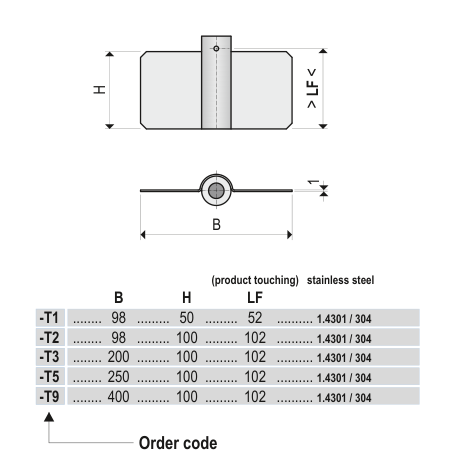
| T1 / T1V T50 paddle (98×50 mm) | 150 / 300 kg/m³ | 250 / 500 kg/m³ |
| T2 / T2V T100 paddle (98×100 mm) | 100 / 200 kg/m³ | 200 / 450 kg/m³ |
| T5 T250 paddle (250×100 mm) | 15 / 20 kg/m³ | 20 / 30 kg/m³ |
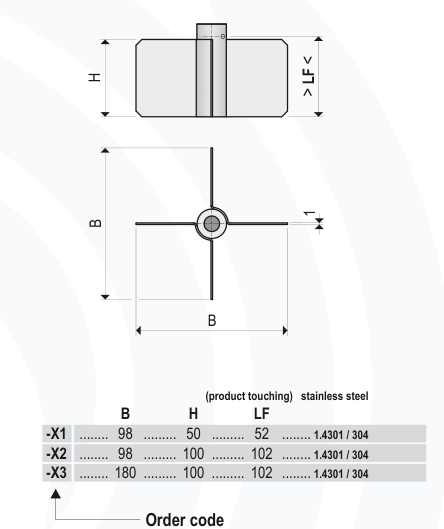
| X1 X50 paddle (98×50 mm) | 150 / 300 kg/m³ | 250 / 500 kg/m³ |
| X2 X100 paddle (98×100 mm) | 100 / 200 kg/m³ | 200 / 450 kg/m³ |
| X3 X200 paddle (180×100 mm) | 25 / 50 kg/m³ | 75 / 150 kg/m³ |
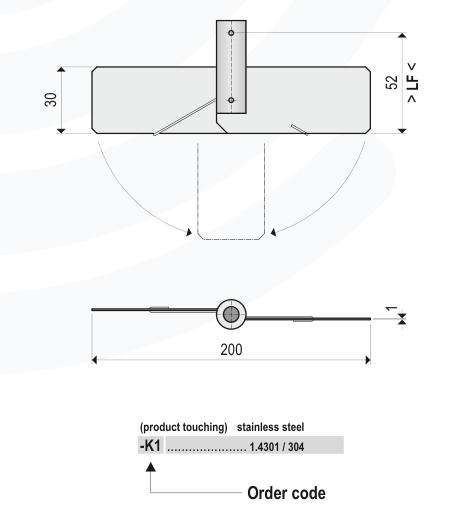
| K1 folding paddle (200×30 mm) | 50 / 80 kg/m³ | 70 / 120 kg/m³ |
| SG paddle (126×8 mm) | 450 / 550 kg/m³ | 650 / 750 kg/m³ |
| TG paddle (98×8 mm) | 500 / 600 kg/m³ | 700 / 800 kg/m³ |
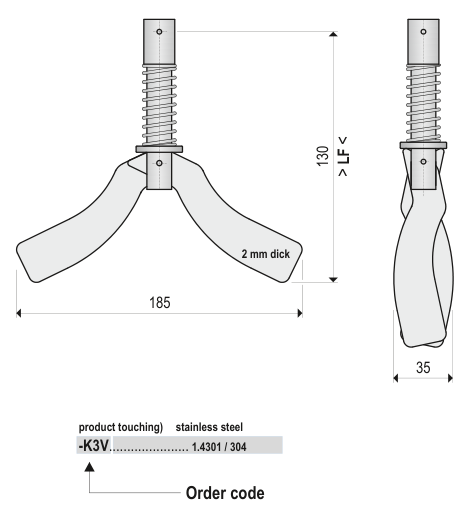
| K3V reinforced folding paddle (185×28 mm) | 80 / 120 kg/m³ | 100 / 150 kg/m³ |
| T9 (400×100 mm; model compatibility separately confirmed) | 5 / 10 kg/m³ | 10 / 20 kg/m³ |
The values below are approximate minimum bulk densities from page 58 (DF-PL-52) of the MOLLET 05/2025 catalogue. Conversion: 1 t/m³ = 1 kg/L = 1000 kg/m³. The first value applies to filling up to 100 mm above the paddle; the second to full coverage.
How should the table be read?
Example: at an effective bulk density of 120 kg/m³, M2V meets the light-spring threshold with coverage up to 100 mm above the paddle; M2V does not meet the fully covered medium-spring threshold of 300 kg/m³. Read density, spring setting and coverage together.
Wide paddles such as T5 or X3 may suit very light products; smaller SG/TG surfaces may suit dense products. This is not an automatic ordering rule: verify model fit, particle size, adhesion, impact, direction and shaft loading.
Fluidized material during pneumatic filling can behave lighter than catalogue or laboratory density at rest. MOLLET requires this effect to be considered. No numerical strong-spring threshold is published in this table, so do not derive one.
A larger paddle is not always better
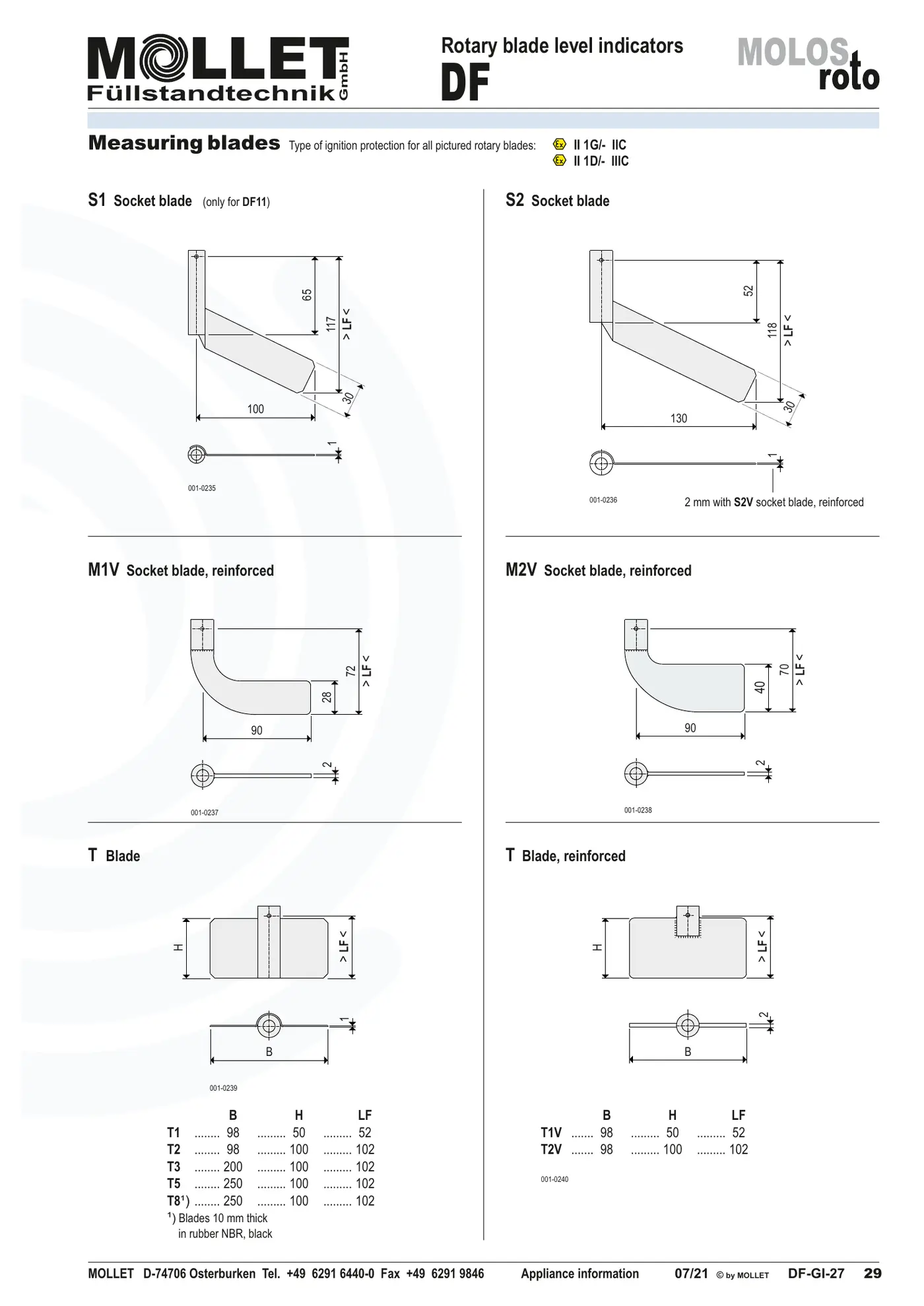
A larger surface can aid detection of light materials but increase impact and mechanical loads. Narrow/special paddles may suit confined spaces. Select with housing, shaft/cable design and mounting position, not sensitivity alone.
Check model label and order code when changing the paddle code. Physical fit does not automatically mean compatibility with certification or process conditions.
Information to send for technical assessment
Provide material, approximate density and particle size, top/side mounting, L between connection and sensing point, temperature, pressure, any Ex zone and the existing nameplate photo. These enable joint model/paddle verification.
Continue selection
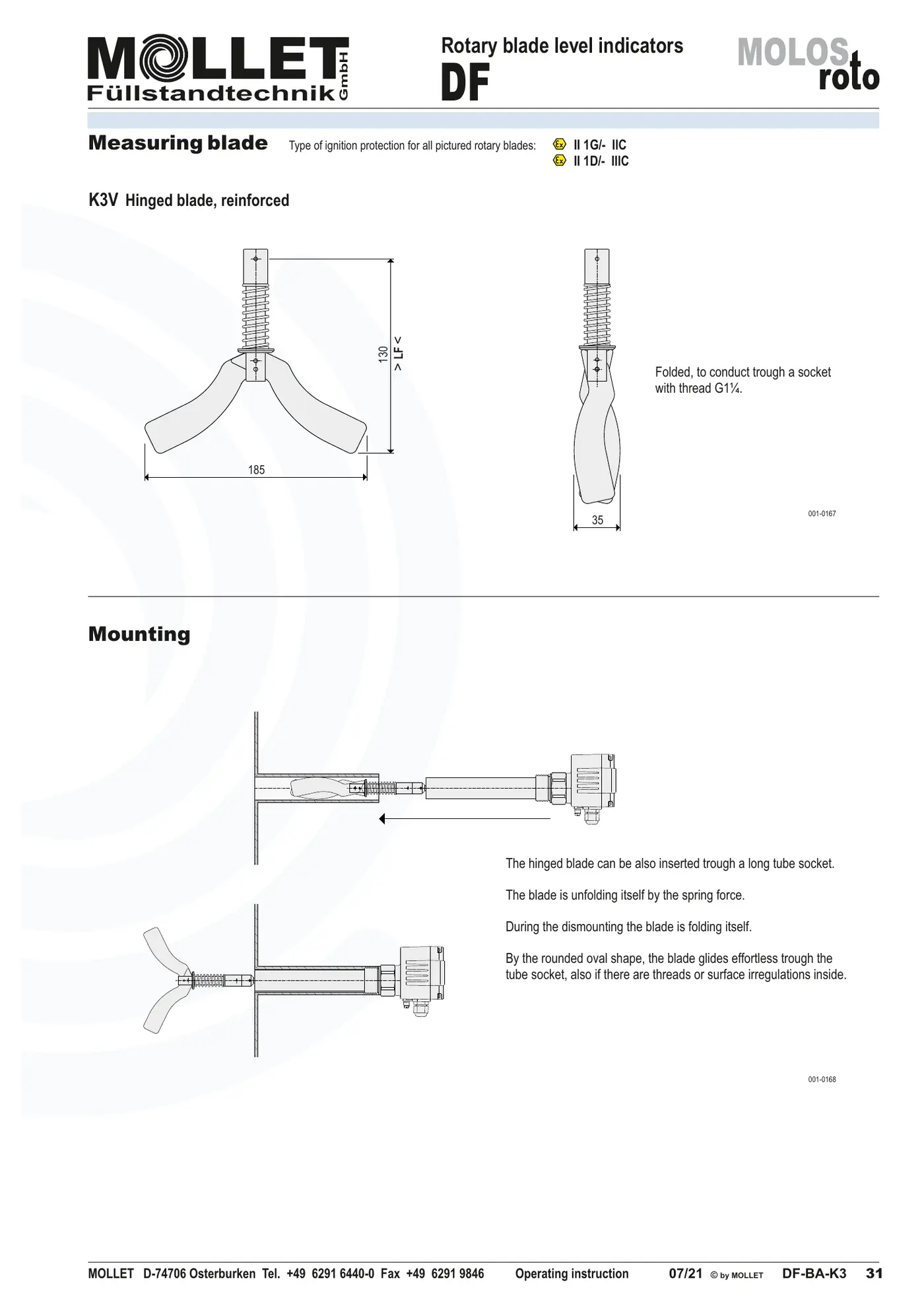
Catalogue drawings
Technical documents
MOLLET DF device and installation information
Download document ↓
Sources
Which paddle is considered for very light products such as 20 kg/m³?
The 05/2025 table gives T5 thresholds of 15/20 kg/m³ for light and 20/30 kg/m³ for medium spring (up to 100 mm above paddle / fully covered). T9 has lower thresholds, but model fit requires confirmation. Final selection checks product behavior, model and mechanical load.
Can I increase sensitivity just by enlarging the paddle?
Not always. More surface can aid detection but also increase load; check housing, shaft and mounting together.
How do I find the same paddle as on my old device?
Match technically using nameplate, complete order code, paddle photo and basic dimensions.